
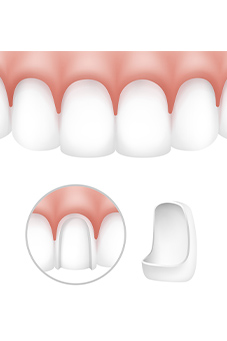
Dental Veneers
Today, thanks to advanced dental technology, the appearance of problems such as fractures, cracks, caries, staining, and yellowing can be eliminated by using different types of dental veneers. Thus, the teeth can gain an aesthetic appearance.
The most important thing is to get a natural result in cosmetic dentistry procedures, especially when it comes to front teeth. An artificial tooth image disturbs the person. Color difference and incompatibility with natural teeth are easily noticeable in poorly made dental veneers.
What Are the Types of Dental Veneers?
Dental veneers can be divided into 5 groups according to the materials used:
1-Metal-Based Porcelain Dental Veneers
It is the oldest dental veneer method. Before starting the procedure, the measurement is taken after the tooth is etched. The dental technician shapes the metal-based product according to the patient's tooth shape with special brushes. Since it is metal-based, there is a possibility that it will not adapt to the gingiva, so it should be tested whether the patient's teeth can adapt to the metal during the examination. In case the gingiva and veneers do not fit, serious problems such as gingival bruising, bleeding, and gingival recession may be encountered. Although metal-based dental veneers are advantageous in terms of being more economical and durable, they lag behind other dental veneers in terms of aesthetics. Even with the best-prepared metal-based dental veneers, it should be considered that problems will arise, such as discoloration at the gingival margin and cutting more of the tooth to tolerate material thickness.
2-Empress Veneers
Metal-based porcelain dental veneers are insufficient due to their appearance far from the natural tooth structure, especially when the front single tooth veneer is required. No matter how skilled the dental technician is, the desired results cannot be obtained with metal-based porcelain veneers in the front single tooth. Full ceramic empress dental veneers were developed for this reason, as a result of the idea of using porcelain without metal in single tooth veneers by strengthening it. This method is suitable for single-tooth veneers. The biggest disadvantage is that they are not as durable as other dental veneers.
3-Zirconium Crowns
Zirconium crowns are much more useful and high-quality methods compared to other dental veneers. Zirconium is an extremely strong material, which makes zirconium crowns very durable. Zirconium crowns are also not as sensitive to cold or heat as metal-based veneers. Therefore, patients can consume everything they eat and drink with their natural teeth with zirconium crowns with peace of mind. Patients who are allergic to metal can prefer zirconium crowns. Since zirconium is both white and transparent, it provides a vivid image similar to natural tooth tissue. It has become the most recommended type of dental veneers/crowns by dentists in recent years.
4-Porcelain Laminate Veneers
Porcelain laminate veneers are half-shaped, unlike other dental veneers, and they are only applied to the front of the tooth. It resembles a fake nail in shape. Today, it is a frequently used method among cosmetic dentistry procedures. Since it is a sensitive method and the material prices are expensive, its price is higher than zirconium dental crowns. Thanks to the laminate porcelain veneer process, yellowing, fractures, or cracks on the tooth surface and gaps between the teeth can be completely corrected.
5-Composite Veneers
Composite veneers are mostly known as composite laminate veneers or dental bonding procedures. Developed composite materials are used during the procedure. Bonding is preferred because it is a very fast and economical procedure that can be completed in a single session. It is commonly used in closing gaps between teeth or correcting tooth lengths or slight deformities. The success of the process needs to use materials of good quality. Before the procedure, the tooth surface is first roughened. Then, a liquid is applied to the teeth so that the composite material can adhere to the tooth. Afterward, bonding materials are adhered to the tooth surface and shaped.